


 ice.cube
 hr.ready
 p.three
 AspiraAI
 Blog
Blog E-Brochures
 Whitepapers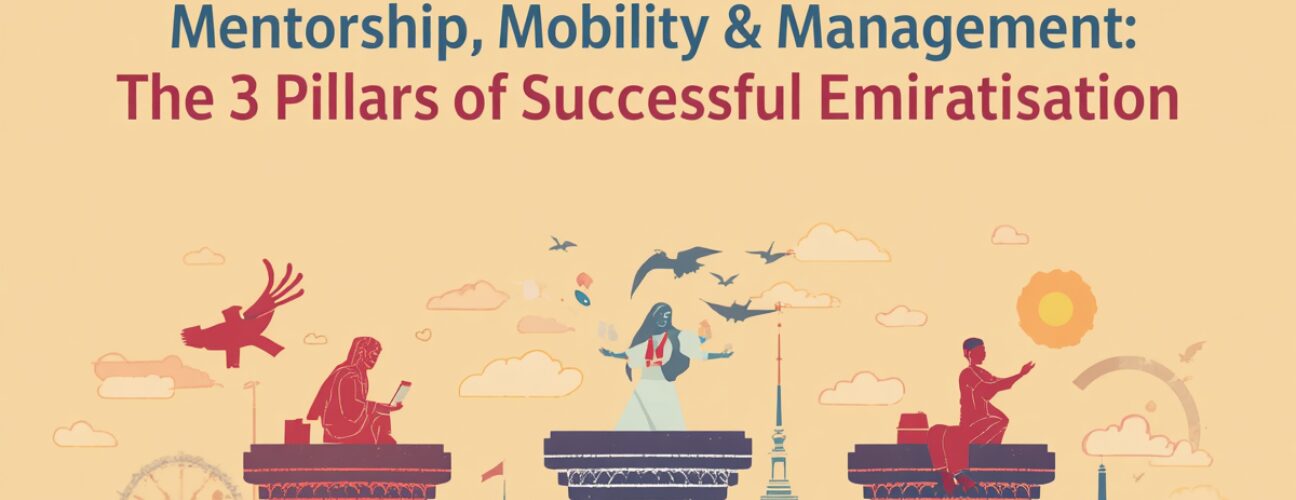
The United Arab Emirates has built one of the world’s most globally integrated economies. Businesses across sectors operate with talent from dozens of nationalities, making the country one of the most diverse professional environments anywhere – closely aligned with evolving global hiring practices.
Alongside this global workforce, the UAE has steadily strengthened its commitment to Emiratisation. The goal is clear: increase the participation of Emirati professionals in the private sector and ensure that national talent plays a meaningful role in shaping the country’s economic future, while balancing both local priorities and global hiring strategies.
Yet the real measure of Emiratisation is not the number of positions filled. It is the number of professionals who grow into confident contributors, decision makers, and future leaders within organisations.
Hiring targets may initiate Emiratisation. But long term success depends on how organisations nurture talent after recruitment. This is where three pillars quietly determine whether Emiratisation becomes transformative or transactional.
Mentorship. Mobility. Management.
These three elements create the conditions where Emirati professionals can develop independence, capability, and long term leadership potential.
Understanding the Purpose of Emiratisation
Much of the public conversation around Emiratisation focuses on compliance. Quotas, regulatory updates, and workforce statistics often dominate discussions.
But the purpose of Emiratisation goes far beyond meeting hiring requirements.
At its core, Emiratisation is about strengthening the UAE’s long term economic resilience by developing a strong national workforce within the private sector, while complementing broader global hiring ecosystems. It aims to ensure that Emirati professionals not only participate in business growth but also lead innovation, decision making, and industry transformation.
The initiative supports several national priorities:
- Increasing participation of UAE nationals in the private sector
- Developing skilled professionals across industries
- Strengthening economic sustainability and national competitiveness
- Building a future ready workforce aligned with the UAE’s development vision
For organisations, this means moving from a short term hiring mindset to a long term talent development and workforce planning strategy.
Companies that invest in developing Emirati professionals often see stronger engagement, improved retention, and more sustainable workforce growth.
Pillar 1: Mentorship that Bridges the Public–Private Sector Gap
A significant challenge in Emiratisation is not capability but transition.
Many Emirati professionals entering the private sector step into organisations where workplace cultures, decision making styles, and performance expectations differ from what they may have previously experienced in academic or public sector environments. Without the right support, this transition can create uncertainty for both employees and managers.
Mentorship helps bridge this gap.
In successful Emiratisation programmes, mentorship goes beyond onboarding. It becomes a structured process where experienced leaders help Emirati professionals understand how the private sector operates, how business decisions are made, and how they can navigate complex organisational environments.
Effective mentorship in Emiratisation typically focuses on:
- Helping Emirati professionals understand private sector work cultures and expectations
- Providing exposure to real business decisions and leadership thinking
- Guiding early career professionals in building long term career pathways within organisations
- Supporting confidence and independence in fast paced corporate environments
Mentorship also plays an important cultural role. It encourages experienced professionals within multinational teams to actively invest in developing national talent.
Over time, this exchange strengthens organisational cohesion while helping Emirati professionals build the confidence needed to take ownership of their roles.
Pillar 2: Mobility that Builds Future Leaders
One of the common concerns raised in Emiratisation discussions is the limited visibility of career pathways within the private sector.
Many Emirati professionals enter organisations through specific roles but may not always see how those roles connect to broader leadership opportunities, especially within organisations influenced by dynamic global hiring structures. Mobility helps solve this challenge.
By creating structured opportunities for Emirati employees to gain experience across different departments or projects, organisations enable them to develop a broader understanding of how businesses operate.
This exposure is critical for building the next generation of Emirati leaders within the private sector.
Organisations that approach Emiratisation strategically often enable mobility through:
- Cross functional project participation that exposes professionals to multiple teams
- Rotational roles that develop operational and strategic understanding
- Leadership acceleration programmes designed specifically for Emirati talent
- Participation in transformation or innovation initiatives
Mobility also demonstrates organisational commitment. When Emirati professionals see clear growth pathways, it reinforces that their role within the company is not symbolic but strategically important.
This clarity strengthens engagement, retention, and leadership development.
Pillar 3: Management that Integrates National Talent into Core Teams
Another challenge organisations face with Emiratisation is ensuring that Emirati employees are not placed in isolated roles or viewed as compliance hires.
Real success comes when Emirati professionals are integrated into core business teams and decision making processes.
This is where management practices become critical.
Managers must move beyond simply hiring national talent and instead focus on creating an environment where Emirati professionals are trusted with meaningful responsibilities and visible career progression.
Strong management practices that support Emiratisation often include:
- Clearly defining roles where Emirati professionals contribute to core business objectives
- Providing regular development feedback and career discussions
- Investing in targeted training that strengthens professional capabilities
- Encouraging collaboration between Emirati and multinational teams
Leadership also plays a role in shaping workplace perception. When management actively champions Emirati professionals and their growth, it reinforces that national talent development is a strategic priority for the organisation.
This integration strengthens both team cohesion and long term workforce stability.
Encouraging a Positive Approach to Emiratisation
Organisations that succeed with Emiratisation often share one common characteristic. They approach it as an opportunity rather than an obligation.
When companies view Emiratisation through a positive lens, the focus shifts from regulatory compliance to team development and long term capability building.
A positive approach typically includes:
- Encouraging mentorship and knowledge sharing
- Providing clear career progression opportunities
- Supporting leadership development for Emirati professionals
- Creating inclusive workplace cultures where collaboration thrives
Such an environment helps build a future-ready workforce and benefits everyone within the organisation.
Teams become stronger, professional growth accelerates, and Emirati employees gain the confidence needed to take on greater responsibilities over time.
Enabling Emiratisation Through Smarter Talent Access
As organisations strengthen their Emiratisation strategies, one challenge remains consistent: identifying and engaging the right Emirati talent within an increasingly competitive global hiring landscape.
SolveCube helps address this through its AI powered talent platform, connecting organisations with curated professional talent pools across industries. The platform enables companies to efficiently search, shortlist, and engage qualified professionals while ensuring strong alignment with skills and organisational needs.
For organisations working toward Emiratisation goals, this means faster access to the right local talent and stronger workforce planning.
If your organisation is looking to strengthen its Emiratisation strategy, SolveCube can help you discover and engage the professionals needed to build a future ready workforce.
Reach out to the SolveCube team at [email protected] to learn more.

Chandru Pingali, Founder & Manager Director, Solvecube, is a seasoned corporate leader, with a diverse career spanning 30+ years across banking, pharmaceutical, chemical and IT/ITES global centres. He has engaged in different roles across HR and Strategy, setting or scaling captive centres, M&A, etc. With SolveCube, he is aiming to revolutionize People Strategy, Advisory & Talent Solutions globally, by utilizing deep AI technology.