


 ice.cube
 hr.ready
 p.three
 AspiraAI
 Blog
Blog E-Brochures
 Whitepapers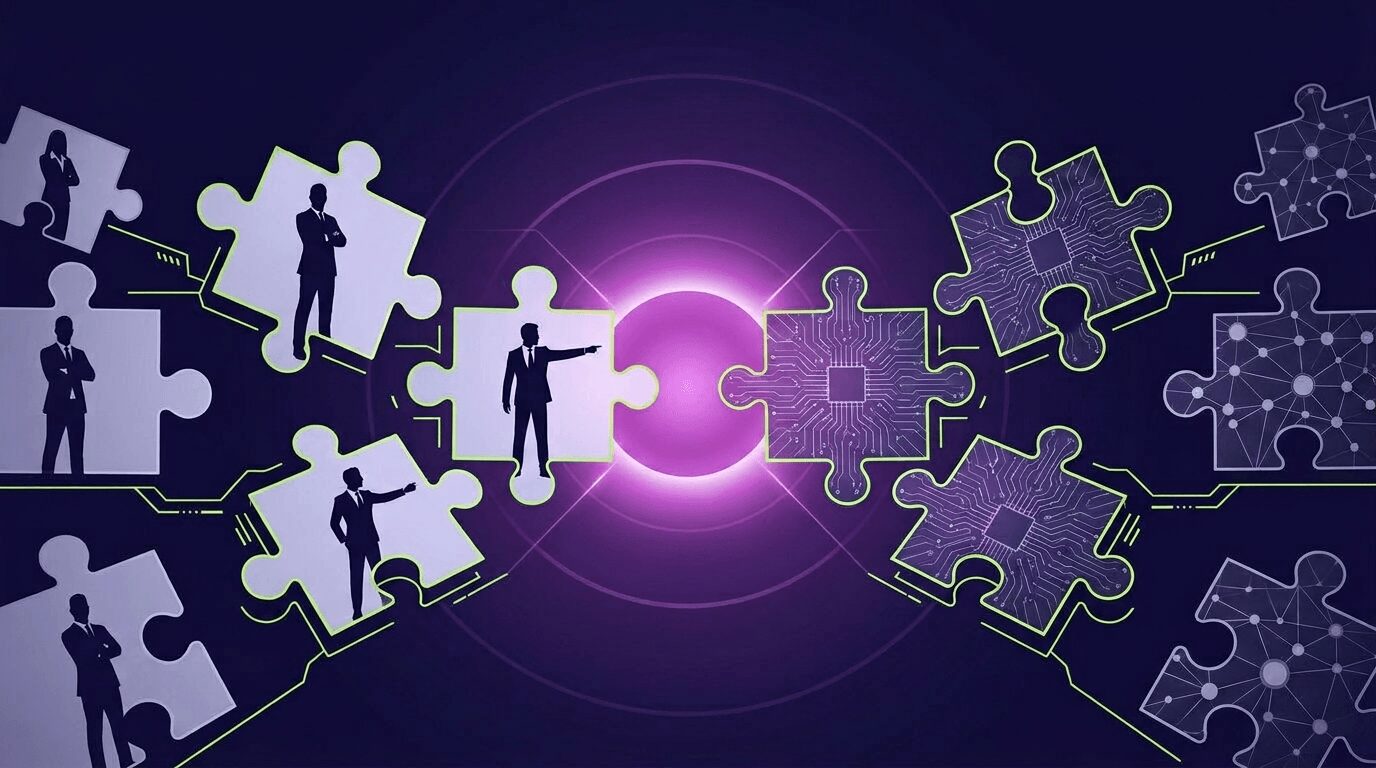
Artificial Intelligence has moved from experimentation to execution. It now influences how organisations hire, make decisions, and operate at scale. From intelligent automation to predictive systems, AI continues to redefine the mechanics of work.
Yet, the conversation around AI often becomes unnecessarily polarised. It frames the future as a trade-off between machine efficiency and human capability.
This framing creates confusion.
The real shift is not about choosing between AI and human intuition. It is about understanding how both can coexist, complement each other, and collectively shape a more resilient workforce.
Organisations that recognise this early will move ahead with clarity. Those that do not risk building systems that are efficient but disconnected from real-world complexity.
AI Brings Scale and Speed, but Not Context
AI delivers measurable advantages. It processes large volumes of data, identifies patterns, and executes repetitive tasks with precision. Businesses rely on these capabilities to reduce costs and improve turnaround times.
However, AI operates within defined parameters. It depends on the quality of inputs, the structure of training data, and the logic embedded within its systems.
It does not inherently understand context.
It cannot independently interpret ambiguity, assess long-term implications, or navigate complex human dynamics. These capabilities continue to rely on human judgment. For example, an AI system can efficiently shortlist candidates based on predefined criteria. However, evaluating cultural fit, leadership potential, or long-term alignment requires experience and intuition.
This distinction highlights an important reality. AI enhances execution, but humans shape direction.
The Workforce Is Evolving, Not Shrinking
Concerns around job loss dominate most discussions on AI. While automation will replace certain tasks, it will also redefine roles and create new opportunities. Work is becoming more dynamic. Roles now require professionals to collaborate with intelligent systems, interpret outputs, and make informed decisions based on both data and experience.
This shift places a new demand on organisations and individuals. They must prioritise adaptability. The primary risk is not displacement. It is irrelevance.
Professionals who do not update their skills will find it difficult to stay aligned with changing expectations. Organisations that fail to support this transition will struggle to fully leverage their AI investments.
This is why the focus must move from job protection to capability development.
Why Continuous Learning Has Become a Business Imperative
Traditional training models no longer meet the needs of an AI-driven environment. Static learning programs cannot keep pace with rapidly evolving technologies and market conditions.
Organisations need systems that enable continuous learning. Knowledge must update in real time. Expertise must remain accessible when decisions are being made, not after.
Without such systems, gaps begin to appear:
- AI outputs lose relevance over time
- Teams struggle to interpret insights effectively
- Decision-making becomes reactive rather than strategic
Continuous learning bridges this gap. It ensures that both technology and people evolve together. The organisations that embed learning into their workflows will build stronger, more adaptive teams.
Where AI Alone Falls Short in Practice
As organisations scale AI adoption, certain limitations become more visible. These are not failures of technology but reflections of its dependency on human input.
AI systems often struggle in areas that require:
- Contextual interpretation of data
- Cross-functional decision-making
- Ethical judgment and accountability
- Creative problem-solving in uncertain environments
These limitations highlight the need for a collaborative model.
AI must operate alongside human expertise, not in isolation. The strength of this collaboration determines how effectively organisations can translate data into meaningful outcomes.
Bridging the Gap: Integrating AI with Real-World Expertise
Forward-looking organisations have started to move beyond basic automation. They are building ecosystems where AI systems continuously learn from human expertise.
This approach ensures that:
- AI remains aligned with industry realities
- Knowledge evolves alongside changing conditions
- Systems improve in accuracy and relevance over time
At this stage, the role of domain experts becomes critical. They do not just use AI systems. They shape them.
They provide the context that AI lacks. They refine outputs. They ensure that automation supports strategic objectives rather than operating in isolation.
This integrated approach defines the next phase of workforce transformation.
How SolveCube Enables This Shift
Platforms like SolveCube operate within this integrated model by combining AI capabilities with access to domain expertise.
SolveCube introduces AI-powered agentic bots that simplify workflows by enabling faster communication and reducing operational delays. These systems improve responsiveness and streamline routine interactions across hiring and business processes.
However, the defining element lies in how these systems evolve.
SolveCube connects organisations with experienced professionals through its Experts On Demand network. These experts contribute directly to the development and refinement of AI systems by:
- Providing domain-specific knowledge
- Continuously updating training inputs
- Aligning outputs with industry requirements
This ensures that AI systems remain dynamic rather than static.
Instead of treating automation as a one-time implementation, SolveCube supports an ongoing process of learning and improvement. This allows organisations to scale AI without losing the depth and accuracy that human expertise provides.
From Efficiency to Intelligent Capability
The shift organisations must make is subtle but significant. It is not enough to implement AI for efficiency. The goal must be to build intelligent capability.
Efficiency focuses on speed and cost reduction. Capability focuses on adaptability, relevance, and long-term performance. By combining AI systems with continuous expert input, organisations can achieve both.
They can operate faster while making better decisions. They can scale processes without compromising context. They can remain competitive in environments that continue to evolve. This balance is what defines sustainable success in an AI-driven world.
Conclusion: The Future Is Not AI or Humans. It Is Both
Artificial Intelligence will continue to expand its role across industries. Its ability to drive efficiency and scale will remain unmatched.
At the same time, human intuition will become increasingly important. As systems grow more complex, the need for judgment, context, and strategic thinking will only increase. The future of work will not be shaped by one replacing the other. It will be shaped by how effectively organisations combine both.
The organisations that succeed will not ask whether to adopt AI. They will focus on how to integrate it with human expertise in a way that drives continuous learning and long-term value.
SolveCube represents one such approach, where AI and human intelligence evolve together to build more resilient, future-ready organisations.
Explore more at: https://www.solvecube.com

Chandru Pingali, Founder & Manager Director, Solvecube, is a seasoned corporate leader, with a diverse career spanning 30+ years across banking, pharmaceutical, chemical and IT/ITES global centres. He has engaged in different roles across HR and Strategy, setting or scaling captive centres, M&A, etc. With SolveCube, he is aiming to revolutionize People Strategy, Advisory & Talent Solutions globally, by utilizing deep AI technology.