


 ice.cube
 hr.ready
 p.three
 AspiraAI
 Blog
Blog E-Brochures
 Whitepapers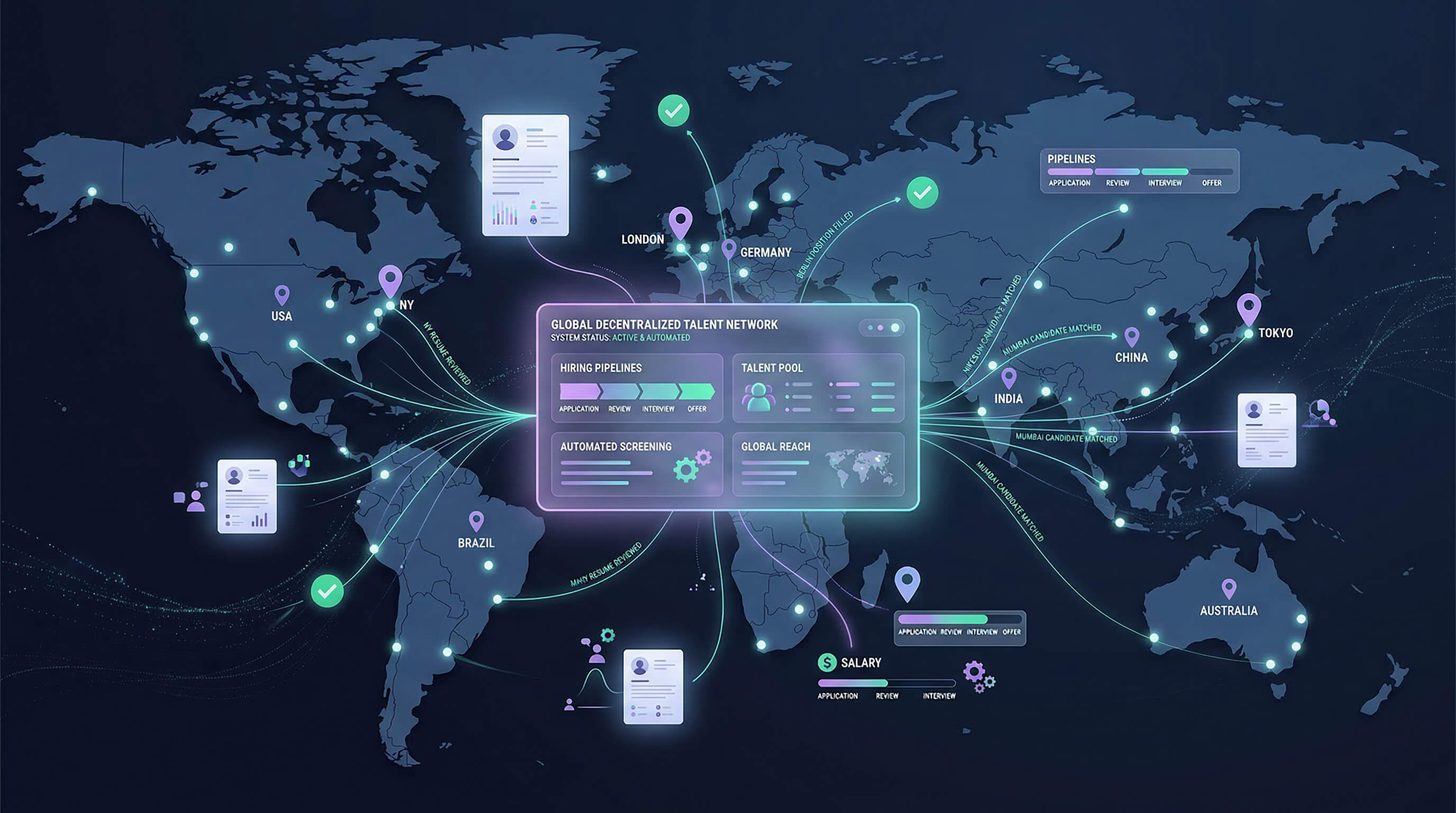
Global hiring has shifted from a long-term ambition to an immediate operating reality for today’s startups. In 2025, many founders choose to hire internationally without HR team structures in place. They prioritise speed and access to global talent over building internal HR departments. The combination of remote work maturity, persistent skill shortages, and rising salary benchmarks in major cities has reshaped how early-stage companies think about talent.
The World Economic Forum’s Future of Jobs Report 2025 predicts that around 170 million new jobs will be created globally by 2030, even as 92 million existing roles are displaced. This transformation in labour markets reinforces the need for agile hiring strategies that can span borders and adapt to shifting global demand.
What plays out at the level of global labour markets shows up in very practical ways for startup teams trying to build products, ship features, and enter new markets with limited resources. Execution speed depends on access to specialised skills, while scaling depends on building resilient teams across geographies. When startups learn how to hire global talent without HR friction, they unlock speed, flexibility, and competitive advantage from day one.
The Structural Shift in How Startups Build Teams
The global workforce model has fundamentally changed. Remote collaboration is no longer experimental. Distributed teams are now normal across product, engineering, growth, customer success, and operations. As a result, geographic boundaries no longer define where talent can contribute meaningfully.
Recent research indicates that the global freelance workforce crossed 1.57 billion people in 2025, reflecting the scale of cross-border and flexible skilled work that organisations increasingly tap into. For founders, this changes how teams get built. Instead of treating global expansion as a later-stage milestone, many startups now design themselves as global from the outset.
Talent strategy becomes tightly linked to product velocity and delivery timelines. When local hiring markets cannot supply the required expertise fast enough, global hiring shifts from being a tactical workaround to becoming a core growth enabler.
At the same time, the cost of building internal HR operations early in a company’s lifecycle remains high. Early-stage startups optimize for speed of learning, speed of iteration, and speed of execution. Adding heavy operational layers too early introduces fixed costs and slows decision-making. This is why founders increasingly hire international talent through varied engagement models, including off-roll and flexible structures, allowing them to access global expertise without immediately building full-scale HR teams to manage those resources.
Why Global Hiring Used to Be Hard
For much of the last two decades, global hiring came with heavy operational drag. Companies had to manage legal presence, payroll compliance, and country-specific labour regulations across every geography they entered. This model suited large enterprises with dedicated HR and legal functions, but it created structural barriers for startups and scale-ups.
The friction was multi-layered. Entity setup delayed hiring timelines. Compliance requirements demanded specialised local knowledge. Employment contracts varied widely across jurisdictions, turning hiring into a persistent legal risk. Each additional geography multiplied complexity and slowed execution.
For startups, this translated into hesitation and trade-offs. Founders delayed critical hires, limited geographic reach, or compromised on talent quality to avoid compliance exposure. In high-demand digital and technical roles, this created a structural disadvantage in competing for scarce skills.
Why This Constraint No Longer Holds
Today, global hiring no longer needs to sit on top of heavy organisational infrastructure. Technology forward global hiring platforms have reduced much of the operational friction that once made cross-border hiring slow and risky. Instead of building HR operations country by country, startups can now access compliant employment and workforce administration as an operating layer.
The strategic shift is not about outsourcing HR for convenience. It is about removing legal and administrative complexity from the founder’s critical path. When hiring decisions are no longer blocked by entity setup or regulatory overhead, access to global talent becomes a practical execution advantage rather than a theoretical option.
Recruitment Without a Big HR Team Is Now Structurally Viable
While compliance and employment infrastructure form the backbone of global hiring, recruitment itself remains one of the most resource-intensive functions for early-stage teams. Sourcing, screening, coordinating interviews across time zones, and closing offers typically require recruiter bandwidth that many startups do not have.
This is where AI-enabled hiring platforms reshape the operating model. Instead of relying on fragmented networks or manual resume screening, founders can now access global talent pools with intelligent shortlisting and structured hiring workflows. Screening cycles shorten. Candidate prioritisation becomes clearer. Hiring execution becomes repeatable rather than ad hoc.
For global-first startups, this removes one of the biggest practical bottlenecks to scaling distributed teams without building full HR recruitment capacity.
Strategic Benefits of Hiring Internationally Without HR
Hiring globally without internal HR infrastructure creates compounding advantages for startups operating in fast-moving markets. According to Gartner, the share of organisations employing borderless tech talent has doubled in recent years, with 58% now reporting technology professionals working remotely from other countries.
The strategic benefits are tangible:
- Faster time to hire: Global access removes local hiring bottlenecks and protects execution velocity.
- Access to scarce skills: International hiring unlocks specialised capabilities that local markets cannot supply at scale.
- Stronger execution quality: Distributed expertise deepens delivery across engineering, data, and product functions.
- Founder focus on growth: Reduced operational overhead keeps leadership attention on customers, revenue, and product.
- Low-risk market testing: Early regional hires enable demand discovery before committing to full market expansion.
Together, these advantages turn global hiring into a growth accelerator rather than an operational compromise.
The Future of Global-First Hiring
Global hiring is moving toward infrastructure-led operating models. AI-driven talent discovery, streamlined compliance, and unified workforce visibility will increasingly become standard layers of startup execution.
The startups that benefit most will be those that treat global hiring not as a workaround, but as a core design principle. Borderless teams, when structured with clarity and supported by strong operating infrastructure, become a source of resilience in volatile markets.
To conclude, the ability to hire internationally without a dedicated HR team is now a strategic competency. With the right global hiring infrastructure in place, startups can build distributed teams, scale faster, and compete for talent on a global stage without carrying the full weight of traditional HR overhead.
Explore how Solvecube enables compliant global hiring and Employer of Record services:
https://www.solvecube.com/global-hiring/

Chandru Pingali, Founder & Manager Director, Solvecube, is a seasoned corporate leader, with a diverse career spanning 30+ years across banking, pharmaceutical, chemical and IT/ITES global centres. He has engaged in different roles across HR and Strategy, setting or scaling captive centres, M&A, etc. With SolveCube, he is aiming to revolutionize People Strategy, Advisory & Talent Solutions globally, by utilizing deep AI technology.