


 ice.cube
 hr.ready
 p.three
 AspiraAI
 Blog
Blog E-Brochures
 Whitepapers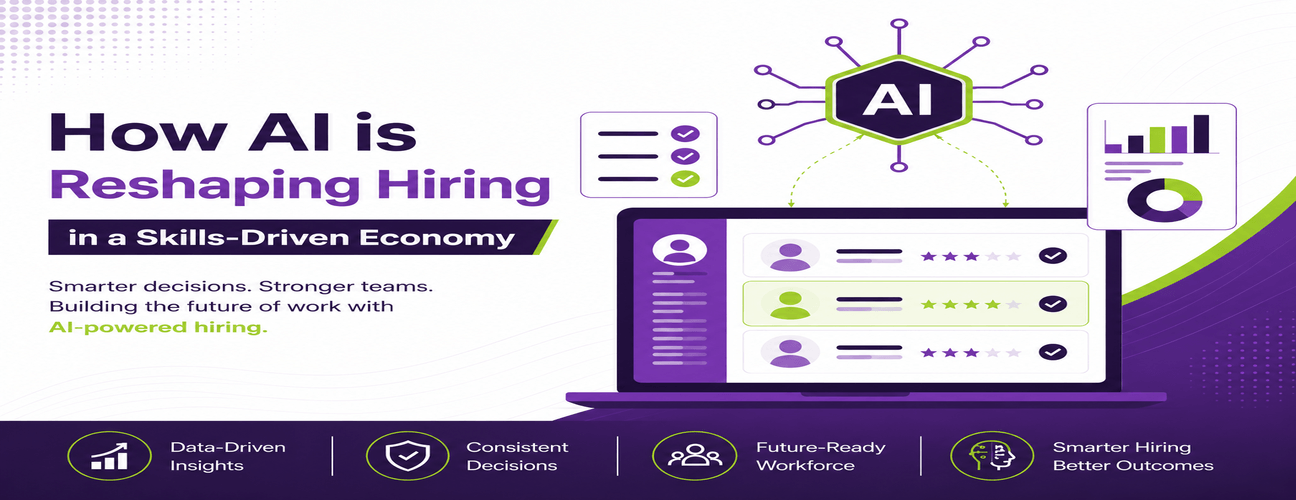
What Is AI in Hiring?
AI in Hiring refers to the use of artificial intelligence to improve how organisations identify, evaluate, hire, and develop talent.
Unlike traditional recruitment methods that primarily focus on resumes, job titles, and years of experience, AI analyses:
- Skills and competencies
- Labour market trends
- Workforce capabilities
- Candidate-job alignment
- Emerging business needs
The objective is simple: to help organisations make more informed, data-driven talent decisions.
As businesses face increasingly complex workforce challenges, AI is rapidly becoming a foundational component of modern hiring strategies.
Hiring has not dramatically changed overnight.
It has quietly evolved into something fundamentally different.
Roles are no longer stable. Skills are no longer static. What worked as a hiring benchmark five years ago is already losing relevance.
According to the World Economic Forum, 170 million new jobs will be created by 2030 while 92 million roles will be displaced, driven largely by technology and AI.
This is not simply a hiring challenge.
It is a recalibration of how work itself is defined.
For employers, the implication is clear. The focus can no longer remain on filling roles. It must shift toward understanding skills and preparing for the future of work.
From Job Descriptions to Skill Intelligence
One of the most significant shifts in recruitment today is the move from job-centric hiring to skill-centric hiring.
Job titles are becoming less meaningful than the capabilities behind them.
A candidate’s previous role does not fully represent what they can contribute next. The skills required tomorrow may not always be reflected in yesterday’s experience.
This is where AI in Hiring introduces a new layer of clarity.
AI transforms hiring into a mapping exercise. It connects individual skills with market demand, allowing employers to evaluate relevance instead of relying on assumptions.
This shift enables organisations to:
- Focus on demonstrated capabilities
- Identify transferable skills
- Reduce dependency on degrees alone
- Improve workforce diversity
- Build future-ready talent pipelines
- Align hiring decisions with business outcomes
It also reduces reliance on outdated indicators such as linear career paths and conventional screening filters.
The result is a more accurate understanding of talent potential and workforce capability.
The Employer Advantage in the Age of AI
While AI creates value across the hiring ecosystem, its impact on employers is particularly strategic.
1. Improved Precision and Speed
Employers no longer need to manually navigate large volumes of unfiltered applications.
AI narrows the focus to candidates who demonstrate genuine alignment with both the role and evolving market demand.
Benefits include:
- Faster hiring cycles
- Better candidate quality
- Reduced recruiter workload
- Improved hiring efficiency
2. Greater Workforce Foresight
Through Talent Intelligence, organisations gain visibility into emerging skill trends.
Hiring becomes aligned with future business requirements rather than immediate staffing gaps.
This enables:
- Better workforce planning
- Reduced future talent shortages
- More strategic hiring investments
3. Continuous Workforce Development
AI does not stop at hiring.
Integrated Skill Gap Analysis helps organisations identify development opportunities and create targeted upskilling pathways.
This transforms hiring from a transactional activity into a long-term capability-building strategy.
Where Traditional Hiring Breaks Down
Despite access to advanced technologies, many organisations continue to rely on hiring systems built for a very different era.
Common challenges include:
- Job descriptions that fail to reflect current skill requirements
- Resume screening based primarily on keyword matching
- Subjective decision-making
- Limited visibility into future workforce needs
This creates a persistent disconnect between what organisations need and how they hire.
The consequences are significant:
- Candidates are evaluated on past roles rather than future relevance
- Hiring cycles become longer due to inefficient filtering
- Workforce planning remains reactive
- Hiring quality suffers
In an increasingly competitive hiring environment, these inefficiencies become barriers to growth.
Why AI-Driven Talent Intelligence Is Different from Traditional ATS Platforms
Most Applicant Tracking Systems (ATS) were designed to solve an operational challenge.
They help organisations collect resumes, organise applications, track candidates, and streamline recruitment workflows.
For many years, that was enough.
Today, it isn’t.
The challenge organisations face is no longer administrative.
It is strategic.
Employers are struggling to identify future-ready talent, anticipate changing skill requirements, and build workforce capabilities aligned with business growth.
This is where AI-driven Talent Intelligence platforms such as AspiraAI operate differently.
Instead of functioning as passive databases, Talent Intelligence platforms continuously analyse:
- Real-time labour market trends
- Emerging skill demands
- Workforce capabilities
- Industry hiring patterns
- Business growth requirements
The result is a hiring strategy informed by market intelligence rather than assumptions.
Traditional ATS vs AI-Driven Talent Intelligence
| Traditional ATS | AI-Driven Talent Intelligence |
| Organises applications | Analyses talent potential |
| Resume-centric | Skills-centric |
| Reactive hiring | Predictive hiring |
| Administrative focus | Strategic workforce focus |
| Tracks applicants | Identifies workforce opportunities |
| Supports recruitment | Supports business growth |
This distinction matters because organisations are no longer competing only for talent.
They are competing for skills.
How AI Rewrites the Hiring Equation
Traditional hiring often relies on approximation.
Recruiters review resumes. Hiring managers evaluate experience. Decisions are made based on credentials, assumptions, and historical indicators.
AI introduces intelligence into that process.
By analysing real-time job market data, workforce trends, and skill requirements, AI enables employers to align hiring decisions with actual demand.
Hiring becomes evidence-based rather than instinct-driven.
Three shifts stand out:
1. Evaluation Becomes Skills-Focused
Traditional systems often prioritise job titles and resume keywords.
AI focuses on capabilities.
It evaluates what candidates can do rather than what they have previously been called.
2. Decision-Making Becomes Faster
Structured insights help employers identify relevant candidates more efficiently.
This reduces screening effort while improving candidate quality.
3. Workforce Planning Becomes Proactive
Instead of reacting to talent shortages, organisations can anticipate future skill requirements and plan ahead.
This allows hiring to support business transformation rather than simply respond to it.
This is the essence of modern HR Tech.
Technology is not replacing human judgment.
It is helping organisations make better decisions.
Upskilling as a Core Hiring Strategy
One of the most significant outcomes of AI in Hiring is the integration of Upskilling into workforce strategy.
Hiring alone cannot keep pace with changing skill demands.
Even the most successful recruitment efforts cannot continuously solve every capability gap through external hiring.
Organisations must develop talent from within.
AI makes this possible by identifying:
- Existing workforce strengths
- Capability gaps
- Emerging skill requirements
- Future business needs
This enables highly targeted learning and development initiatives.
Instead of broad training programmes, organisations can focus on specific areas that create measurable business impact.
For employers, this creates a more resilient workforce.
Employees are not simply hired for what they know today.
They are prepared for what they will need tomorrow.
How AI-Driven Hiring Works in Practice
The value of AI in Hiring becomes most visible when applied to real workforce challenges.
Consider a technology company expanding its AI and automation capabilities.
The organisation may receive thousands of applications for specialised roles. Traditional recruitment methods often struggle to identify candidates with adjacent or transferable skills, resulting in longer hiring cycles and missed opportunities.
AI-driven Talent Intelligence changes that.
By analysing skills rather than relying solely on job titles, employers can identify candidates whose capabilities align with evolving project requirements. This improves shortlist quality while significantly reducing screening effort.
Now consider a manufacturing organisation undergoing digital transformation.
The company may struggle to recruit specialised talent externally. Instead of relying entirely on hiring, AI-driven Skill Gap Analysis can identify existing employees with the potential to transition into future-ready roles through targeted upskilling programmes.
In both scenarios, hiring becomes:
- Faster
- More strategic
- More cost-effective
- Better aligned with long-term workforce transformation
The outcome is not simply improved recruitment.
It has improved organisational capability.
Talent Intelligence: The Missing Link Between Hiring and Workforce Planning
Many organisations still treat hiring, learning, and workforce planning as separate functions.
The reality is that they are deeply connected.
Talent Intelligence serves as the bridge between them.
It helps organisations answer critical questions such as:
- Which skills are becoming more valuable?
- Which capabilities are missing from our workforce?
- Where should we invest in hiring?
- Where should we invest in upskilling?
- Which employees have potential for future roles?
These insights create a far more connected workforce strategy.
Instead of reacting to talent shortages after they occur, organisations can anticipate change and prepare for it.
That capability is becoming one of the most important competitive advantages in modern business.
The Rise of Global, Skill-First Teams
The hiring landscape is becoming increasingly borderless.
Remote work, digital collaboration, and global connectivity have fundamentally changed how organisations access talent.
Today, companies are no longer restricted by geography when building high-performing teams.
Instead, they are focusing on capabilities.
Employers are increasingly prioritising:
- Relevant skills over location
- Capability over proximity
- Potential over traditional credentials
- Adaptability over rigid career paths
This shift has given rise to Global Hiring models that allow organisations to access specialised talent wherever it exists.
For employers, the benefits are significant:
- Access to larger talent pools
- Faster hiring cycles
- Improved workforce flexibility
- Better access to niche skills
- Greater organisational agility
AI supports this transition by helping organisations identify, evaluate, and match talent at scale across multiple geographies.
As businesses become increasingly global, hiring strategies must evolve accordingly.
A New Mindset for Employers
The organisations that will lead in the Future of Work are not necessarily those that hire faster.
They are the ones that hire smarter.
This requires a fundamental shift in mindset.
1. Hiring Must Be Continuous
Talent strategy cannot begin only when a vacancy appears.
Organisations must continuously monitor capability requirements and workforce readiness to stay ahead of change.
2. Skills Must Be Dynamic
The shelf life of skills is shrinking.
Workforces must evolve continuously to remain competitive in a rapidly changing environment.
3. Decisions Must Be Data-Driven
Workforce planning can no longer rely solely on intuition.
Modern organisations require visibility into skills, capability gaps, and future talent requirements.
At the centre of this transformation lies Talent Intelligence, connecting hiring, workforce planning, capability development, and business growth into a unified strategy.
Frequently Asked Questions About AI in Hiring
How Is AI Changing Hiring?
AI is changing hiring by helping organisations analyse skills, identify workforce gaps, improve candidate matching, and make more informed talent decisions.
Rather than relying solely on resumes and job titles, AI focuses on capabilities, market demand, and future workforce requirements.
How Does AI Help Identify Skill Gaps?
AI compares workforce capabilities against current and future business requirements.
It identifies areas where critical skills are missing and helps organisations create targeted hiring and upskilling plans to address those gaps.
What Is the Difference Between an ATS and an AI Talent Intelligence Platform?
An ATS primarily helps organisations manage applications and recruitment workflows.
An AI-driven Talent Intelligence platform goes much further.
It helps organisations:
- Analyse workforce capabilities
- Predict future skill requirements
- Identify capability gaps
- Improve workforce planning
- Build future-ready talent strategies
The difference is administrative efficiency versus strategic workforce intelligence.
Can AI Improve Workforce Planning?
Yes.
AI enables organisations to anticipate future workforce requirements, identify emerging skills, and align hiring decisions with long-term business objectives.
This allows workforce planning to become proactive rather than reactive.
AspiraAI: Turning Hiring into Intelligence
As workforce complexity grows, organisations need more than recruitment software.
They need intelligence.
AspiraAI by SolveCube is designed to help organisations align talent decisions with real-time market demand through advanced AI-driven insights.
Unlike conventional hiring platforms that focus primarily on managing applications, AspiraAI helps organisations understand:
- Skill relevance
- Workforce readiness
- Emerging talent trends
- Capability gaps
- Future workforce requirements
This enables employers to move beyond transactional recruitment and adopt a more strategic, insight-led approach to hiring.
Through its core capabilities, AspiraAI helps organisations:
-
Map Talent Profiles to Market Demand
Understand how workforce capabilities align with changing industry requirements.
-
Identify Workforce Gaps
Conduct structured Skill Gap Analysis to uncover capability shortages.
-
Improve Candidate Quality
Access curated, high-fit candidate shortlists aligned with business needs.
-
Enable Targeted Upskilling
Support long-term workforce development through personalised learning pathways.
-
Strengthen Workforce Planning
Connect hiring decisions directly to business transformation goals.
The result is a hiring process that is not only more efficient but significantly more aligned with long-term organisational success.
The Road Ahead
The future of hiring will not be defined by access to talent alone.
It will be defined by the ability to understand it.
In a world shaped by AI in Hiring, the real advantage lies in clarity.
Knowing which skills matter.
Knowing where those skills exist.
Knowing how those skills are evolving.
The organisations that succeed will be those that continuously align workforce capabilities with business transformation.
Because hiring is no longer about filling roles.
It is about building capability in a world where the definition of capability keeps changing.
Ready to Build a Smarter Talent Strategy?
Discover how AspiraAI by SolveCube can help your organisation align hiring, workforce planning, Skill Gap Analysis, and Upskilling into a single intelligence-driven strategy.
Explore AspiraAI and see how AI-powered Talent Intelligence can help you build a future-ready workforce.
Visit: www.solvecube.com
Or connect with our team for a personalised walkthrough and demo.

Chandru Pingali, Founder & Manager Director, Solvecube, is a seasoned corporate leader, with a diverse career spanning 30+ years across banking, pharmaceutical, chemical and IT/ITES global centres. He has engaged in different roles across HR and Strategy, setting or scaling captive centres, M&A, etc. With SolveCube, he is aiming to revolutionize People Strategy, Advisory & Talent Solutions globally, by utilizing deep AI technology.