


 ice.cube
 hr.ready
 p.three
 AspiraAI
 Blog
Blog E-Brochures
 Whitepapers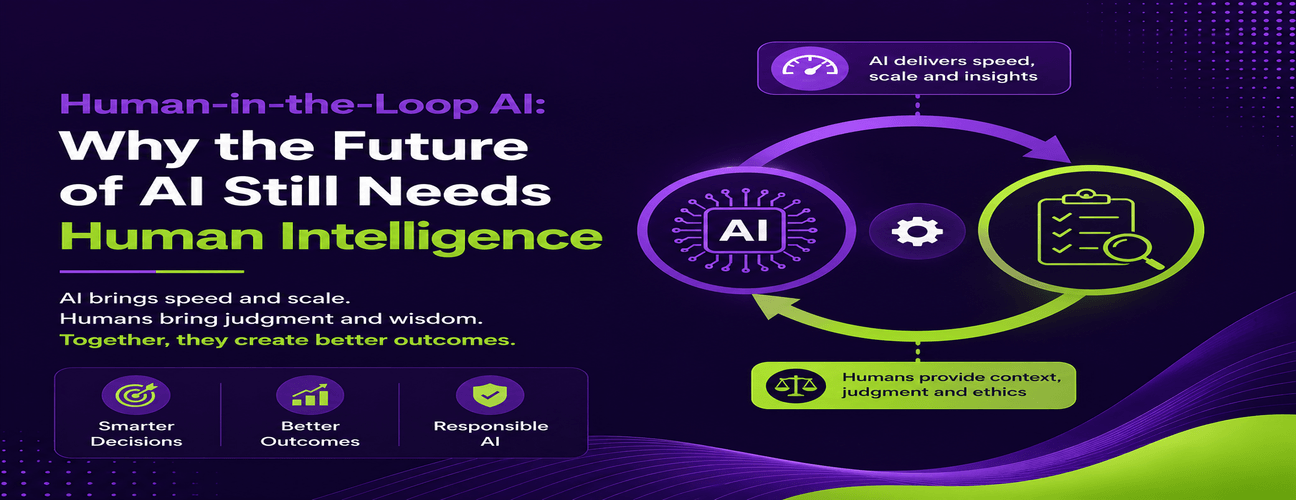
What Is Human-in-the-Loop AI?
Human-in-the-Loop AI (HitL) is an approach where human experts continuously review, refine, and improve AI outputs.
Instead of operating independently, AI systems learn from expert feedback, enabling them to improve accuracy, contextual understanding, and decision-making quality over time.
Human-in-the-Loop AI is commonly used across:
- Customer Experience (CX)
- Healthcare
- Financial Services
- Legal and Compliance
- HR Technology
- AI Model Training
This approach ensures AI remains aligned with real-world requirements rather than relying solely on historical training data.
Artificial Intelligence is no longer an emerging capability.
It is already embedded across business functions, quietly shaping how organisations operate, interact, and scale.
From customer support systems to internal workflows, AI has moved from experimentation to expectation. Businesses now rely on it to respond faster, operate leaner, and deliver consistent outcomes at scale.
But as adoption deepens, a more nuanced reality is beginning to surface.
AI systems perform exceptionally well in structured environments, yet they often struggle to adapt to ambiguity, nuance, and evolving business contexts.
They may respond, but not always accurately.
They may automate, but not always intelligently.
And in moments where judgment matters most, the absence of human insight becomes visible.
This is the challenge organisations are now facing. Not whether to adopt AI, but how to make it truly effective.
As enterprises invest heavily in AI transformation, a new reality is emerging. Building AI models is becoming easier. Making them reliable, context-aware, and commercially valuable is becoming significantly harder.
Why AI Still Needs Human Intelligence
Most AI systems are trained using structured documentation, historical datasets, and predefined knowledge sources.
While this creates a strong foundation, real-world environments are rarely predictable.
Unexpected questions emerge.
Industry-specific scenarios evolve.
Customer expectations change.
Business contexts shift.
These situations expose gaps that data alone cannot fill.
Common challenges include:
- Limited understanding of domain-specific nuance
- Lack of contextual depth in complex scenarios
- Difficulty adapting to changing business requirements
- Inconsistent responses in high-stakes situations
This is where Human-in-the-Loop AI becomes essential.
Domain experts help AI systems interpret complexity, correct outputs, and introduce context that structured data alone cannot provide.
Their expertise is continuously fed back into the system, creating a learning loop that improves future responses.
Over time, a powerful balance emerges.
AI provides scale, speed, and pattern recognition.
Humans provide judgment, context, and relevance.
Together, they create systems that are not only automated but adaptive.
How Human-in-the-Loop AI Works
Human-in-the-Loop AI operates across two interconnected layers.
Layer 1: Foundational Learning
AI systems are trained using:
- Documentation
- Historical datasets
- Knowledge repositories
- Structured business information
This creates the baseline understanding required for operation.
Layer 2: Expert Refinement
As AI encounters real-world interactions, questions arise that fall outside its original training data.
This is where human experts step in.
They:
- Interpret complex situations
- Validate responses
- Correct inaccuracies
- Provide contextual guidance
- Improve decision quality
The resulting insights are fed back into the system, creating a continuous improvement cycle.
Instead of remaining static, the AI evolves with every interaction.
Why Human-in-the-Loop AI Matters for Business
As AI adoption scales, organisations are no longer looking for automation alone.
They want intelligence that is:
- Reliable
- Context-aware
- Adaptable
- Commercially viable
Without Human-in-the-Loop AI, systems risk becoming:
- Inaccurate in critical situations
- Disconnected from business realities
- Ineffective in delivering consistent experiences
- Difficult to trust at scale
For organisations, this directly impacts customer experience, operational efficiency, and decision-making quality.
Human-in-the-Loop AI ensures that systems evolve alongside the business rather than falling behind it.
How Human-in-the-Loop AI Applies Across Industries
The value of HitL becomes even clearer when applied to real enterprise environments.
-
Healthcare
AI systems supporting patient engagement, documentation, and clinical workflows often require expert validation to ensure responses remain accurate and context-sensitive.
Human expertise helps maintain precision where outcomes directly affect patient care.
-
BFSI
AI-powered customer support, risk assessment, and fraud detection systems frequently encounter complex financial scenarios.
Human-in-the-Loop refinement improves decision accuracy while helping organisations navigate regulatory requirements and reduce operational risk.
-
Legal and Compliance
AI tools assisting with contract analysis, policy interpretation, and document review benefit from expert oversight that ensures outputs remain aligned with legal frameworks and industry terminology.
-
Customer Experience (CX)
In customer-facing environments, expert intervention helps AI systems handle escalations, ambiguity, and emotionally sensitive interactions more effectively.
Across industries, the pattern remains consistent.
AI performs best when supported by continuous human intelligence and domain expertise.
What is HITL AI’s Impact on Customer Experience
One of the most visible benefits of Human-in-the-Loop AI is its impact on customer experience.
AI-powered systems are increasingly becoming the first point of interaction between businesses and customers.
When responses are accurate and context-aware, trust grows.
When they are not, friction follows.
With expert-driven refinement, organisations can:
- Deliver more accurate responses
- Handle complex queries effectively
- Improve customer trust
- Maintain consistency across interactions
- Strengthen service quality at scale
Beyond CX, these benefits extend into operations, workforce productivity, and business decision-making.
AI becomes more than a tool.
It becomes a dependable business capability.
Frequently Asked Questions About Human-in-the-Loop AI
What Is Human-in-the-Loop AI?
Human-in-the-Loop AI is an approach where human experts continuously review and improve AI outputs, helping systems become more accurate, context-aware, and reliable over time.
Why Is Human-in-the-Loop AI Important?
Human-in-the-Loop AI helps bridge the gap between data and real-world complexity. It improves accuracy, reduces risk, and enables AI systems to adapt to evolving business environments.
Which Industries Benefit Most from Human-in-the-Loop AI?
Industries such as Healthcare, BFSI, Legal, Compliance, Customer Experience, HR Technology, and Enterprise AI benefit significantly because they rely on context-rich decision-making.
Does Human-in-the-Loop AI Improve AI Accuracy?
Yes.
By incorporating expert feedback into training and refinement processes, Human-in-the-Loop AI helps improve response quality, contextual understanding, and decision accuracy over time.
The SolveCube Approach: Experts Powering AI
This is where SolveCube brings a distinct advantage.
Through its Expert on Demand model, SolveCube connects organisations with a rapidly deployable global network of domain experts who actively train, refine, and improve AI systems with real-world intelligence.
This enables enterprises to access specialised expertise across industries and geographies without the delays associated with traditional hiring or consulting models.
SolveCube helps organisations:
- Access curated domain experts on demand
- Improve AI training and refinement
- Strengthen contextual understanding
- Address knowledge gaps as they emerge
- Continuously improve AI accuracy and relevance
Experts become intelligence layers within the AI ecosystem, shaping behaviour, improving outputs, and ensuring alignment with business goals.
The Road Ahead: Why Building Intelligence That Learns is important
The future of AI will not be defined by how widely it is deployed.
It will be defined by how effectively it performs when it matters.
As organisations embed AI deeper into customer interactions, decision-making, and core operations, expectations are shifting.
Speed alone is no longer enough.
Accuracy, context, adaptability, and domain relevance are becoming critical differentiators.
This is where Human-in-the-Loop AI delivers its greatest value.
AI brings scale, consistency, and processing power.
Human expertise brings judgment, context, and the ability to navigate ambiguity.
Together, they create systems that learn, adapt, and improve continuously.
The organisations that succeed will not simply deploy AI.
They will build intelligence systems that evolve alongside their business, remain aligned with real-world complexity, and generate stronger outcomes over time.
Because the real advantage is not in using AI.
It is in building AI that continues to learn.
Ready to Strengthen Your AI with Human Intelligence?
Discover how SolveCube’s Expert on Demand model can help your organisation build more accurate, adaptive, and context-aware AI systems.
Connect with our team to explore how Human-in-the-Loop AI can accelerate AI performance, improve customer experiences, and drive better business outcomes.

Chandru Pingali, Founder & Manager Director, Solvecube, is a seasoned corporate leader, with a diverse career spanning 30+ years across banking, pharmaceutical, chemical and IT/ITES global centres. He has engaged in different roles across HR and Strategy, setting or scaling captive centres, M&A, etc. With SolveCube, he is aiming to revolutionize People Strategy, Advisory & Talent Solutions globally, by utilizing deep AI technology.