


 ice.cube
 hr.ready
 p.three
 AspiraAI
 Blog
Blog E-Brochures
 Whitepapers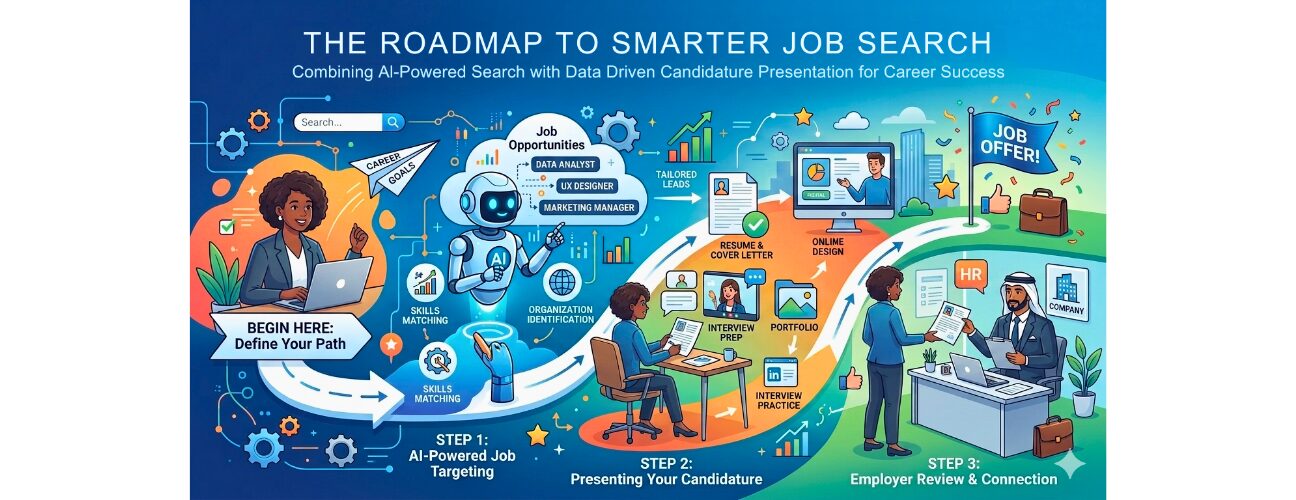
For most professionals today, the biggest challenge in finding a job is not a lack of opportunities. It is the overwhelming number of them.
Thousands of job listings appear across multiple platforms every day. Candidates search across job boards, company websites, recruitment portals, and professional networks, often applying to dozens of roles without knowing whether those opportunities truly match their profile.
The result is a familiar cycle: search, apply, wait, and repeat.
Despite the effort, many candidates still feel uncertain about whether they are targeting the right opportunities or whether their skills align with what employers actually want.
Artificial intelligence is beginning to change this experience.
Instead of relying on manual searches across fragmented platforms, AI powered tools now help professionals understand where they fit in the job market, which roles match their profile, and what steps can improve their chances of success.
The future of job searching is no longer about applying everywhere. It is about applying strategically.
The Challenge with Traditional Job Searching
The traditional job search model has remained largely unchanged for years. Most professionals follow a similar pattern: browse listings, apply to multiple roles, and hope that one opportunity converts into an interview.
However, this approach has several limitations in today’s digital hiring environment.
Professionals often encounter three common challenges:
- Fragmented job discovery across multiple platforms and websites
- Random applications to roles that may not align with their experience
- Limited visibility into skill gaps preventing them from reaching desired roles
Ironically, while candidates still apply manually, many employers now rely on automated technologies to screen applications before recruiters review resumes.
Research from Harvard Business School shows that around 75% of companies in the United States use automated recruitment systems to screen resumes, and adoption rises dramatically among large enterprises. Nearly 99% of Fortune 500 companies rely on Applicant Tracking Systems (ATS) to process and filter candidate applications before recruiters review them.
In this environment, sending a high volume of applications without clear alignment often reduces the likelihood of success.
AI Is Transforming the Job Search Process
Artificial intelligence is quickly becoming an important tool for both employers and job seekers.
AI systems can analyze job postings, identify hiring patterns, and match candidate profiles against employer requirements. This allows professionals to gain insights into the job market that were previously difficult to access.
Recent research highlights how widely AI is already being used during job searches.
AI in Job Searching: Key Trends
| Trend | Statistic |
| Job seekers using AI tools | 80% use AI-powered platforms to find job opportunities |
| AI improving job discovery | 84% say AI makes job searching easier |
| Candidates using AI for resumes | 68% use AI to write or optimize resumes |
| Trust in AI job recommendations | 76% trust AI-generated job matches |
These trends suggest that AI is increasingly becoming a career intelligence tool, helping professionals interpret job market data and make more informed decisions.
The Power of Targeted Job Searching
Traditional job searching emphasizes quantity. Candidates often apply to as many roles as possible in the hope that one application will succeed. AI driven job search approaches focus instead on precision.
Targeted job searching identifies roles where a candidate’s skills, experience, and aspirations align closely with employer expectations. This approach considers several factors simultaneously:
- professional skills and experience
- employer hiring requirements
- industry demand and role availability
- geographic and sector preferences
By concentrating on opportunities with stronger alignment, candidates improve both response rates and interview opportunities. Rather than sending dozens of uncertain applications, professionals can focus on roles where their profile already demonstrates a strong fit.
Key Stages of Career Planning
AI powered career tools are most valuable when they provide clear direction rather than simply automating applications.
Platforms built around intelligent job matching often support three key stages of career planning.
1. Understanding Your Market Fit
AI analyzes a candidate’s CV and compares it with thousands of job listings, generating a profile-to-market map that highlights roles where the candidate’s experience aligns most strongly with employer expectations.
2. Identifying Skill Gaps
By evaluating job requirements across industries, AI systems can highlight the skills or certifications that may be missing from a candidate’s profile.
This helps professionals focus on targeted upskilling rather than guessing which qualifications might improve their employability.
3. Creating a Strategic Job Search Plan
With insights into both role fit and skill development, candidates can focus their applications on opportunities where they have the highest probability of success.
This turns job searching into a guided and strategic process rather than a trial-and-error exercise.
From Job Applications to Career Navigation with AspiraAI
One of the most valuable advantages of AI powered job search tools is the ability to bring clarity to career decisions. Instead of simply presenting long lists of job openings, advanced platforms analyze market demand alongside a candidate’s professional profile to provide deeper career insights.
Platforms such as AspiraAI by SolveCube apply technologies like artificial intelligence, machine learning, natural language processing, and prompt engineering to evaluate a candidate’s CV and compare it with thousands of past and active job listings. This analysis maps a professional’s skills, experience, aspirations, and preferred locations against real market demand, creating a clear profile-to-market view.
Through this process, candidates gain visibility into key career questions such as:
- Which roles align most closely with my current experience
- How closely my profile matches available job opportunities
- Which industries or locations show stronger demand for my skills
- What additional skills could improve my chances of reaching my target role
The platform also highlights skill gaps and recommends targeted learning pathways that can help candidates strengthen their profile over time.
By bringing together job discovery, skill gap analysis, and curated role matching in one place, tools like AspiraAI help professionals move beyond fragmented job searching toward a more focused and strategic approach to career navigation.
Concluding Note
The job market is evolving rapidly. New roles emerge across industries every year, while skill requirements continue to change with technological progress. Artificial intelligence is helping professionals navigate this complexity by providing clearer insights into career opportunities and market demand.
AspiraAI by SolveCube is designed around this principle of precision career navigation.
By combining profile-to-market mapping, curated job shortlists, skill gap analysis, and upskilling recommendations, the platform enables professionals to approach their job search with greater clarity and confidence.
Instead of chasing every opportunity, candidates can focus their efforts on roles where they are more likely to succeed while building the skills required for future career growth.
For professionals looking to make their job search more strategic and targeted, AI driven tools like AspiraAI offer a smarter way to navigate the modern job market.
To learn more about AspiraAI and how it can support your career journey, reach out to us for a quick demo [email protected].

Chandru Pingali, Founder & Manager Director, Solvecube, is a seasoned corporate leader, with a diverse career spanning 30+ years across banking, pharmaceutical, chemical and IT/ITES global centres. He has engaged in different roles across HR and Strategy, setting or scaling captive centres, M&A, etc. With SolveCube, he is aiming to revolutionize People Strategy, Advisory & Talent Solutions globally, by utilizing deep AI technology.