


 ice.cube
 hr.ready
 p.three
 AspiraAI
 Blog
Blog E-Brochures
 Whitepapers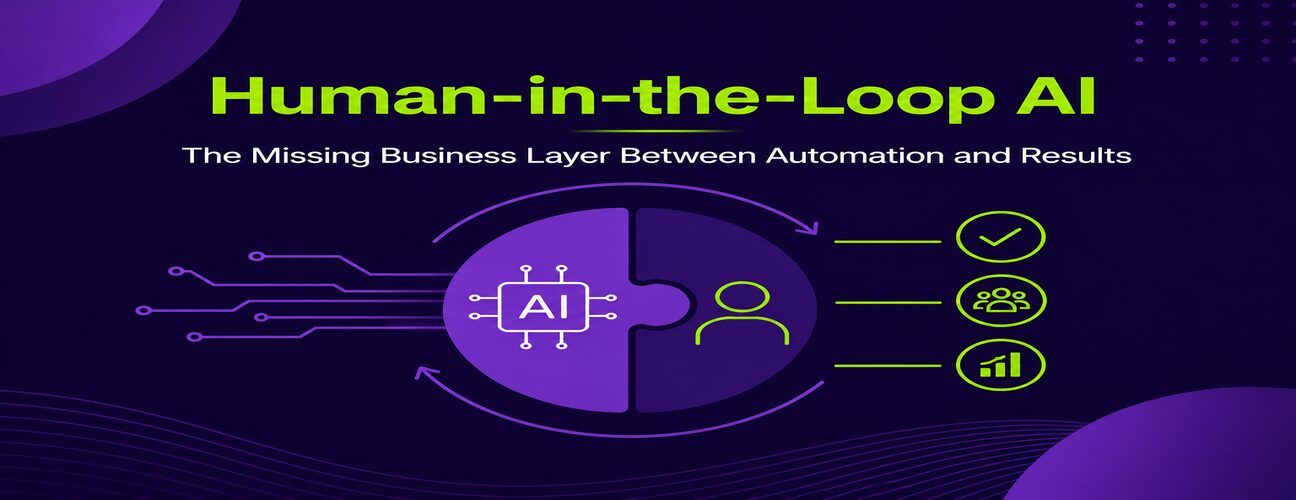
What is the AI Productivity Paradox?
Businesses are investing heavily in AI.
Yet many leaders are discovering an uncomfortable reality. Deploying AI is relatively easy. Generating measurable business outcomes is considerably harder.
Many AI initiatives successfully automate tasks but fail to improve customer satisfaction, decision quality, productivity, or commercial performance. The result is what can be described as the AI Productivity Paradox.
More automation does not automatically create more value.
The organisations generating the highest returns from AI are not necessarily those deploying the most AI. They are the ones that combine technology with expertise in ways that improve outcomes, not just outputs.
This is where Human-in-the-Loop AI begins to matter. Human-in-the-Loop AI (HitL) is a model where human expertise remains actively involved in AI-driven processes. Rather than relying entirely on automation, organisations combine machine intelligence with human judgment, context, validation, and decision-making. The result is an approach that balances the speed of AI with the experience and expertise of people.
Why does Human-in-the-Loop AI Make Business Sense?
Most discussions around Human-in-the-Loop AI focus on model training, validation, and accuracy.
Important considerations, certainly.
But the larger story is business performance.
HitL directly influences how effectively organisations convert AI investments into productivity gains, better decisions, stronger customer experiences, and long-term competitive advantage.
The value extends far beyond technology teams. It influences how businesses learn, adapt, scale expertise, and respond to increasingly complex environments.
How to turn AI Investment into Business Outcomes
Most business challenges are not caused by a lack of data.
They are caused by a lack of clarity.
AI can process enormous volumes of information, identify patterns, and surface recommendations in seconds. However, business decisions rarely depend on data alone. They are influenced by context, customer expectations, market conditions, operational realities, and strategic priorities.
Human-in-the-Loop AI combines machine-driven analysis with human judgment and domain expertise. This creates a decision-making model that is not only faster but significantly more relevant.
The impact is often visible across the organisation:
- Better resource allocation
- Improved customer outcomes
- Faster problem resolution
- Reduced operational errors
- More informed strategic decisions
In many organisations, the greatest contribution of AI is not speed.
It is helping people make better decisions with greater confidence.
What is the biggest barrier to AI adoption?
Despite rapid advances in AI technology, one of the biggest barriers to successful adoption is not the technology itself.
It is trust.
Organisations can deploy sophisticated AI systems, but employees are unlikely to use them consistently if they do not understand how recommendations are generated or whether the outputs can be relied upon.
Human oversight helps close that gap.
When employees know experts are continuously validating, refining, and improving AI systems, confidence grows. Adoption accelerates. Resistance decreases. AI becomes a practical business tool rather than an experimental technology initiative.
Ultimately, successful AI adoption depends as much on trust as it does on technology. The faster organisations build confidence in AI systems, the faster they can unlock productivity gains, improve decision-making, and realise returns from their AI investments.
Competitive Advantage Comes from Better Intelligence
Most organisations today have access to similar AI tools.
Competitive advantage rarely comes from the technology itself.
It comes from how effectively the technology is applied.
Human-in-the-Loop AI introduces proprietary expertise into AI systems. Every expert interaction enriches the intelligence layer supporting the organisation. Over time, businesses build knowledge ecosystems that competitors cannot easily replicate.
This creates a powerful shift.
AI stops being a generic capability and starts becoming a strategic asset.
In a market where competitors can access the same technology, proprietary intelligence becomes one of the few advantages that cannot be easily copied.
How HITL Reduces Risk in High-Stakes Environments
As AI becomes embedded in critical workflows, mistakes become significantly more expensive.
Industries such as healthcare, financial services, legal, compliance, and manufacturing operate in environments where accuracy, accountability, and consistency matter deeply.
In these contexts, Human-in-the-Loop AI acts as an assurance layer.
Experts validate outputs, identify exceptions, interpret context, and ensure recommendations remain aligned with operational, regulatory, and business requirements.
The benefits are tangible:
- Reduced operational risk
- Lower compliance exposure
- Improved decision reliability
- Stronger customer trust
- Better governance
As AI moves closer to mission-critical decisions, the cost of being confidently wrong often exceeds the cost of moving slightly slower.
What is The Hidden Cost of AI Stagnation?
Most organisations worry about AI errors.
Far fewer worry about AI stagnation.
An AI system may perform exceptionally well immediately after deployment, yet become progressively less effective if its knowledge fails to evolve alongside the business.
- Products evolve.
- Customer expectations rise.
- Regulations emerge.
- Industry terminology shifts.
- Market dynamics fluctuate.
Meanwhile, many AI systems continue operating based on assumptions that were valid months ago.
This creates a less visible but equally significant challenge: relevance.
Human-in-the-Loop AI prevents stagnation by introducing continuous expert input into the learning cycle. Rather than relying solely on historical knowledge, organisations create systems that evolve alongside changing business realities.
The question is not whether AI learns.
It is whether it learns fast enough to keep pace with the business it is meant to support.
How HITL Scales Expertise Beyond Individuals
One of the most underestimated business risks today has little to do with technology.
It is the loss of institutional knowledge.
When experienced employees leave, organisations often lose years of expertise, contextual understanding, and decision-making experience. Much of this knowledge exists informally, making it difficult to document, transfer, or scale.
Human-in-the-Loop AI creates an opportunity to change that dynamic.
By continuously capturing expert insights and incorporating them into AI systems, organisations can transform individual expertise into a shared organisational asset. Knowledge becomes accessible, repeatable, and scalable across teams, geographies, and future employees.
The impact extends even further.
Traditionally, expertise scales slowly. An expert can support only a limited number of people, projects, or decisions at any given time.
Human-in-the-Loop AI changes that equation.
A single expert’s knowledge can influence thousands of future interactions, helping organisations distribute intelligence at a scale that would otherwise be impossible.
The organisations that scale expertise most effectively will often outperform those that simply scale headcount.
The Revenue Side of Human-in-the-Loop AI
Most AI discussions focus on efficiency.
Business leaders focus on growth.
Human-in-the-Loop AI contributes to growth by improving the quality of interactions, recommendations, and decisions across the business.
It can influence revenue generation through:
-
Better Customer Experiences
More accurate and context-aware interactions increase trust, retention, and loyalty.
-
Smarter Sales Intelligence
Expert-refined AI systems help identify opportunities, improve targeting, and strengthen customer engagement.
-
More Relevant Personalisation
AI becomes more capable of adapting recommendations to individual customer needs and preferences.
-
Stronger Strategic Decision-Making
Leadership teams gain access to richer insights that improve planning, prioritisation, and execution.
The most valuable AI initiatives are not always the ones that save the most money.
They are often the ones that help businesses create more value.
The Strategic Advantage of HITL in Building an Organisational Learning Engine
This may be the most strategic advantage of all.
Most organisations learn in fragments.
Knowledge sits within departments. Insights remain trapped within teams. Valuable experiences often stay with the individuals who encountered them.
As a result, organisational learning tends to happen slowly and inconsistently.
Human-in-the-Loop AI creates a fundamentally different model.
Every expert intervention, refinement, correction, and recommendation becomes part of a larger learning system. Rather than solving isolated problems, organisations continuously improve their collective intelligence.
Over time, this creates something far more valuable than operational efficiency.
It creates an organisation capable of learning systematically.
Products can be replicated.
Technology can be purchased.
An organisation that learns faster than its competitors is considerably harder to catch.
The Companies Winning with AI Are Building Better Learning Systems
This is the shift many organisations overlook.
The competitive advantage of AI is not the model itself.
Models become commoditised.
Technology becomes accessible.
Tools become available to everyone.
What remains difficult to replicate is organisational intelligence.
The companies generating the greatest returns from AI are not necessarily those with the most advanced algorithms. They are the organisations that continuously combine technology, expertise, feedback, and learning into systems that improve over time.
The real advantage is not better technology.
It is a better system for capturing, applying, and scaling intelligence across the organisation.
Frequently Asked Questions About Human-in-the-Loop AI
What are the business benefits of Human-in-the-Loop AI?
Human-in-the-Loop AI improves decision quality, accelerates AI adoption, reduces operational risk, preserves institutional knowledge, strengthens customer experiences, and continuously improves AI performance.
Why do companies invest in Human-in-the-Loop AI?
Companies invest in HitL because it helps generate stronger business outcomes from AI initiatives while improving trust, accuracy, governance, and operational effectiveness.
How does Human-in-the-Loop AI improve productivity?
AI handles large-scale processing and automation while humans contribute context, judgment, and expertise. Together, they improve efficiency, decision quality, and business performance.
Does Human-in-the-Loop AI create competitive advantage?
Yes. Organisations can embed proprietary expertise into AI systems, creating intelligence capabilities that competitors cannot easily replicate.
Is Human-in-the-Loop AI important for enterprise AI?
Absolutely. As AI becomes embedded into business-critical processes, human oversight becomes increasingly important for governance, adaptability, risk management, and long-term value creation.
How does Human-in-the-Loop AI help businesses scale expertise?
Human-in-the-Loop AI enables organisations to capture expert knowledge and distribute it across teams, systems, and future interactions, making expertise scalable rather than dependent on individual contributors.
The SolveCube Advantage: Expertise at the Speed of AI
The effectiveness of Human-in-the-Loop AI depends on access to the right expertise.
SolveCube’s Expert-on-Demand model helps organisations rapidly access domain specialists who can validate, refine, train, and continuously improve AI systems using real-world knowledge and industry experience.
This enables businesses to:
- Accelerate AI maturity
- Improve model performance
- Reduce implementation risk
- Access specialised expertise globally
- Build continuously improving AI ecosystems
The future belongs not to organisations with the most AI.
It belongs to organisations with the smartest combination of AI and human intelligence.
From Automation to Advantage
The next phase of AI adoption will not be defined by how many processes organisations automate.
It will be defined by how effectively they combine technology with expertise.
Human-in-the-Loop AI represents that evolution.
Not as a safeguard.
Not as a support function.
But as a business capability that helps organisations make better decisions, preserve knowledge, improve adaptability, and create intelligence that compounds over time.
The real winners in the AI era will not be the organisations that automate the most.
They will be the ones that convert expertise into an asset that grows more valuable with every interaction.

Chandru Pingali, Founder & Manager Director, Solvecube, is a seasoned corporate leader, with a diverse career spanning 30+ years across banking, pharmaceutical, chemical and IT/ITES global centres. He has engaged in different roles across HR and Strategy, setting or scaling captive centres, M&A, etc. With SolveCube, he is aiming to revolutionize People Strategy, Advisory & Talent Solutions globally, by utilizing deep AI technology.